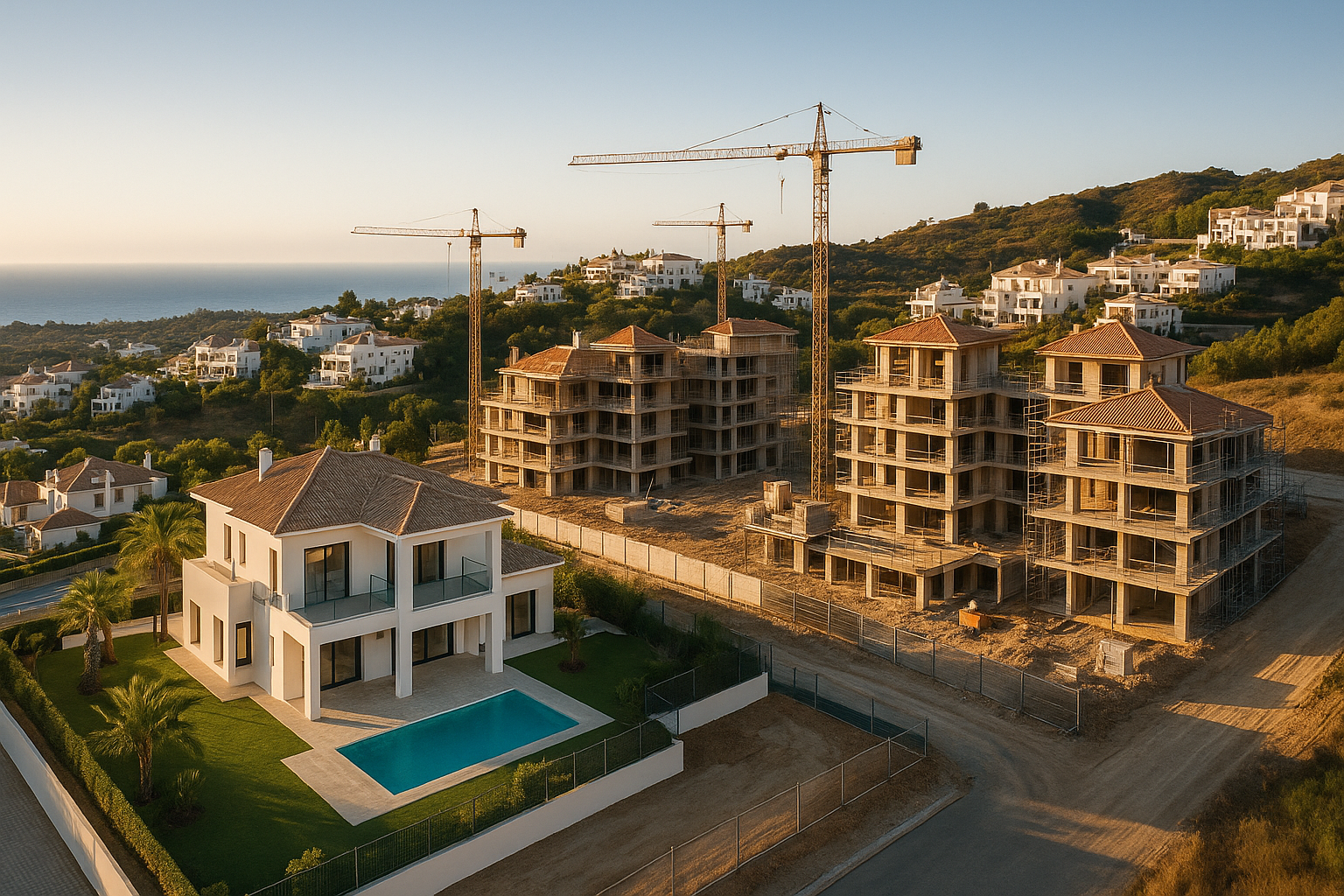

The Costa del Sol continues to be one of Europe’s most attractive real estate markets, especially for buyers seeking modern homes, strong investment returns, and long-term lifestyle benefits. Purchasing off-plan is a preferred strategy for international buyers thanks to flexible payment schedules, competitive launch prices, and the potential for capital appreciation before completion.
This professional guide explains how the off-plan buying process works in 2025–2026, the advantages it offers, the risks involved, and how to protect your investment.
Why Buyers Choose Off-Plan in 2025–2026
Demand for new developments in Marbella, Estepona, Mijas, and Benahavís continues to outpace supply. Many buyers prioritise new homes because they offer:
- Modern, energy-efficient construction
- High-quality communal facilities: swimming pools, gyms, spas, coworking areas, gardens
- Higher rental demand and long-term value
- Lower maintenance costs compared to older properties
Due to limited land in prime areas, off-plan homes often increase in price as construction progresses, creating strong investment potential.
Main Advantages of Buying Off-Plan
-
Lower Entry Price
Launch-phase prices are generally more attractive. Many developments see price increases from early phases to completion.
-
Flexible Payment Structure
Buyers pay gradually, following construction milestones, rather than paying the full amount upfront.
-
Customisation Options
Depending on the stage of construction, buyers can choose finishes and interior materials.
-
Modern Specifications
New-build homes include aerothermal climate systems, underfloor heating, smart-home features, and high energy ratings.
-
Legal Warranty Protection
All off-plan properties in Spain include a 10-year structural warranty under the Ley de Ordenación de la Edificación.
Risks and How to Mitigate Them
-
Construction Delays
Delays can occur due to weather, licensing, or supply chain issues. A strong lawyer ensures proper contractual protections.
-
Developer Quality
Always check the developer’s track record for completed projects and build quality.
-
Mortgage Approval
Financing is only required at completion, but buyers should confirm mortgage eligibility early.
-
Market Conditions
Markets fluctuate, but the Costa del Sol historically shows strong long-term demand.
-
Legal Due Diligence
Your lawyer must verify all building licenses, guarantees, and bank guarantees (Aval Bancario) before any funds are transferred.
Typical Off-Plan Payment Structure
- 1Reservation Fee – fixes the unit and price
- 220% at Private Purchase Contract (minus reservation)
- 310–20% during construction
- 460–70% at completion with the Title Deed
Step-by-Step Buying Process (2025–2026)
- 1
Select the development and unit
- 2
Pay reservation and instruct an independent lawyer
- 3
Legal verification
- 4
Sign the Private Purchase Contract
- 5
Make staged payments
- 6
Pre-completion inspection
- 7
Completion at notary and handover
Mortgage Considerations for Off-Plan Buyers
Spanish banks typically lend 60–70% to non-residents. Pre-approval early in the process helps avoid last-minute complications.
Best Areas for Off-Plan Investment in 2025–2026
- Marbella – high rental demand and strong resale value
- Estepona – excellent quality-to-price ratio
- Mijas Costa – growing demand and strong amenities
- Benahavís – premium new-build communities
- Casares Costa – attractive pricing with increasing popularity
For a deeper look at the most promising developments and investment areas, explore our Top 5 Real Estate Investments in Costa del Sol 2025–2026 guide.
ROI and Appreciation Potential
Off-plan properties commonly appreciate 5–10% from initial launch to completion. New-build homes also achieve higher rental rates and occupancy, especially in tourist-demand areas.
The Bank Guarantee on Your Stage Payments — and the Moment It Does Not Protect You
When you buy off-plan in Spain you hand money to a developer for a building that does not yet exist. The law that governs what happens to that money is the First Additional Provision of the Ley de Ordenación de la Edificación (Ley 38/1999), as amended by Ley 20/2015, in force since 2016. You will still see the older Ley 57/1968 cited everywhere online: it was repealed, and today it matters only for claims arising from purchases made before that date.
Under the current regime the developer must place the deposits received on account into a separate designated account, and back them with an insurance policy or a bank guarantee. This protection is mandatory law: a clause in your contract saying otherwise is void, whatever it says and whoever drafted it.
The gap most buyers never hear about
The statutory guarantee attaches from the moment the developer holds the building licence. Money handed over before that licence exists sits outside the regime. On very early-stage schemes — the ones marketed hardest, with the best prices and the longest horizon — that is precisely when the first payments are requested.
This does not make an early reservation wrong. It makes it a decision you should take knowing what does and does not stand behind your money.
What to ask for, and when to stop paying
- An individual guarantee certificate for each payment, not a general reference to a collective policy.
- Confirmation that the guaranteed amount matches what you actually paid, including VAT.
- Sight of the building licence before any substantial payment.
- If a certificate does not arrive after a payment, do not make the next one. Spanish case law has allowed buyers to claim against the bank holding the special account even without individual paperwork — but a claim is a lawsuit, and a lawsuit is not a substitute for a document you could have had at the time.
From Reservation to Keys: the Three Contracts, and What to Demand at Each
An off-plan purchase in Marbella is not one signature but three, and the deposit process is spread across all of them, — the second is where everything that matters is decided.
1. The reservation
A modest reservation deposit takes the unit off the market for a short window, usually around a month. The only two questions worth asking: what happens to this deposit if you do not proceed, and what happens to it if the developer does not proceed. The answers are often not symmetrical.
2. The private purchase contract
The contrato privado de compraventa is the real document. It fixes the completion date, the specification, the consequences of delay, and what happens if the licence does not arrive. A first substantial payment — commonly around a tenth of the price — falls due here. This is the document to put in front of an independent lawyer, not the brochure and not the renders.
One distinction that causes more disputes than any other: the delivery date in the marketing material and the completion date in the contract are not the same thing. Only one of them is enforceable.
3. The escritura at the notary
The balance is paid, the deed is signed, the keys change hands and the purchase goes to the Land Registry. Before you sign, you should be handed the licence of first occupation, the ten-year structural warranty (seguro decenal), the energy performance certificate, the specification schedule and, where relevant, the community statutes.
The Licence of First Occupation: the One Document You Never Complete Without
The licencia de primera ocupación is issued by the town hall and certifies that what was built matches what was licensed, and that the property is legally fit to live in. It is the difference between a finished building and a legally usable home.
What a property without it actually costs you
- Utilities: water and electricity companies routinely refuse permanent connections without it.
- Mortgage: most Spanish banks will not release funds on a property that lacks it.
- Rental: a tourist rental licence is out of reach.
- Resale: a smaller pool of buyers, and a discount when you eventually sell.
Issue times run from about three to nine months after works are completed, and vary widely between municipalities on this coast. Andalucía now also allows a declaración responsable, under which the developer self-certifies compliance and connections can proceed immediately. It is faster, but it moves the verification onto the developer’s own statement, and the town hall retains the right to inspect afterwards.
On villas the stakes are higher than on apartments. A house built without a licence, or beyond what the licence permitted, can be extremely difficult and expensive to regularise — and that problem passes to whoever owns it.
The rule is simple: do not sign the escritura before the licence, or a valid declaración responsable, is in place. If a developer presses you to complete without it, that is not a scheduling detail. That is the moment to stop and take independent advice.
Whose Side of the Table We Sit On
We are not the sales office for any of the developments we list. The checks above are the ones we run before we put a project in front of a client, and the ones we would want run if we were buying ourselves. If you are looking at a scheme and want an honest read on the developer, the licence position and what is genuinely still available, that is the conversation to have before the reservation, not after it.
This page is general information about how off-plan purchases work in Spain, not legal advice. Every purchase should be reviewed by an independent lawyer acting for you and not for the developer.
Checklist Before Buying Off-Plan
- Verify developer reputation and completed projects
- Ensure all licenses are fully approved
- Confirm bank guarantees for every payment
- Use an independent lawyer
- Understand all payment milestones
- Request estimated community fees
- Confirm expected completion date
- Review specifications and materials
- Check orientation, layout, and views
- Review mortgage requirements early
More Insights on the Costa del Sol Market
Conclusion
Buying off-plan property in the Costa del Sol in 2025–2026 remains one of the most attractive investment opportunities for international buyers. With excellent legal protections, modern specifications, and strong market demand, off-plan properties offer both lifestyle and financial advantages.
For personalised guidance or updated availability of new developments, feel free to request a consultation.